
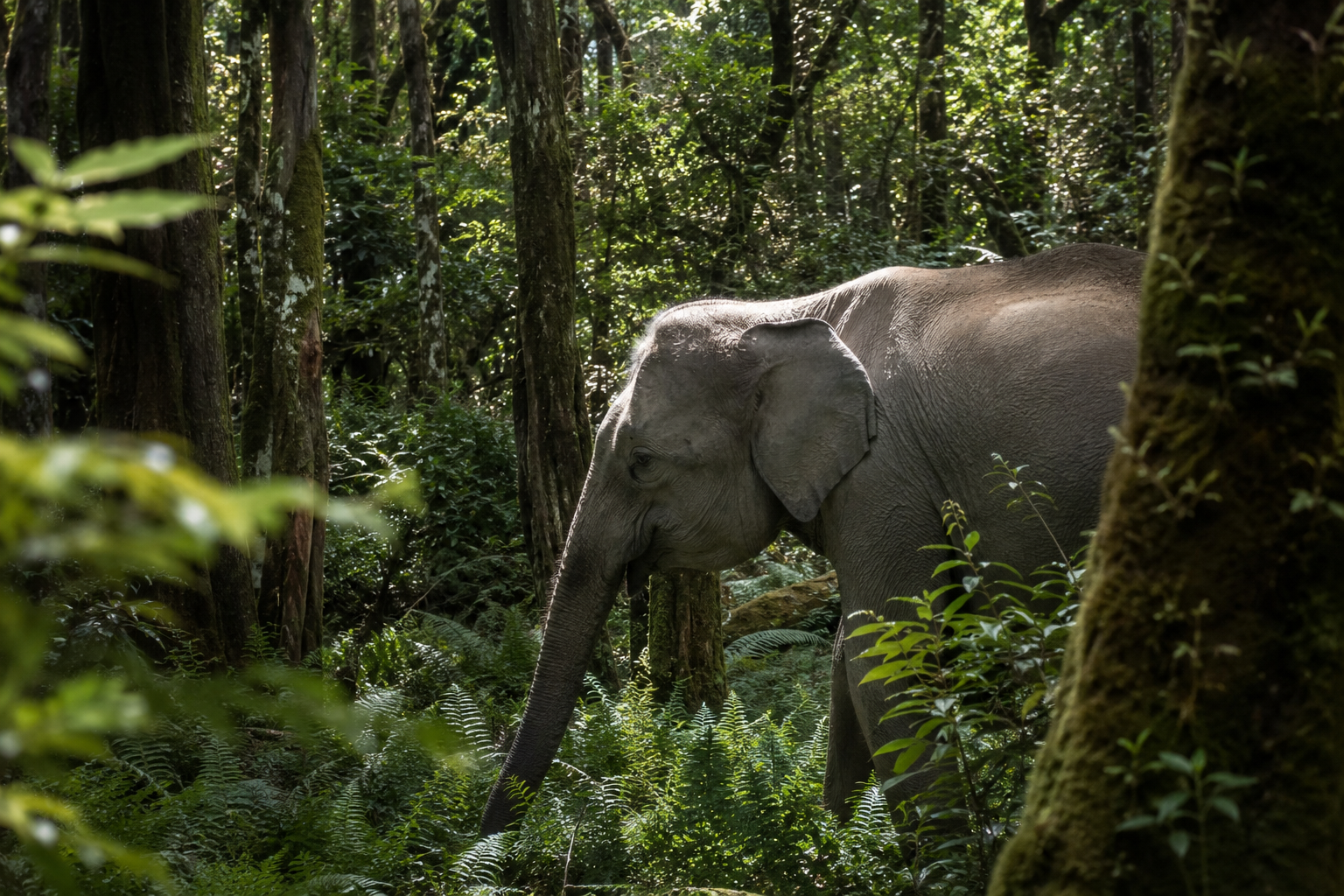
🐘 Oupoot: The Incredible Story of South Africa's Last Knysna Elephant
🌿 Legends & Folklore of South Africa - A Story of Survival, Hope and the Importance of Letting Nature Remain Wild
Hidden deep within the ancient forests of South Africa's Garden Route lives a remarkable survivor.
For decades, she was little more than a whisper among towering yellowwood trees. Foresters spoke of broken branches where no people had walked. Hikers told stories of enormous footprints appearing after overnight rain. Farmers occasionally reported seeing a large grey shadow disappearing silently into the dense forest.
Many believed the stories.
Many doubted them.
Then, in 2025, South Africans received the news they had been hoping for.
The lone female Knysna elephant—affectionately known as Oupoot—had been seen once again.
For conservationists, wildlife lovers and ordinary South Africans, it was more than just another elephant sighting.
It was proof that hope still walks beneath the ancient canopy of the Knysna Forest.
🌳 A Forest Older Than Memory
The Knysna Forest is unlike anywhere else in South Africa.
Unlike the open plains where elephants are usually found, this indigenous forest is a world of towering yellowwood trees, giant ferns, winding streams and cool, shaded valleys. Sunlight filters gently through the dense canopy while the songs of Knysna turacos, woodpeckers and countless other forest birds echo through the trees.
Walking here feels almost timeless.
Mist rolls quietly between the ancient trunks during winter mornings, and every bend in the trail reveals another piece of a landscape that has remained remarkably unchanged for thousands of years.
It is one of South Africa's last great indigenous forests—and the perfect place for nature to keep its secrets.
🐘 When Hundreds of Elephants Roamed These Forests
Long before roads, towns and farms shaped the Garden Route, the Knysna Forest was home to thriving herds of elephants.
Historical records tell of hundreds of elephants moving freely between Knysna and Tsitsikamma. These giants played a vital role in maintaining the health of the forest by opening pathways, dispersing seeds, creating clearings and supporting countless other plant and animal species.
They were not merely visitors.
They were architects of the forest itself.
For centuries, they lived in harmony with this remarkable ecosystem.
💔 A Population Lost
As European settlement expanded during the eighteenth and nineteenth centuries, life for the Knysna elephants changed dramatically.
Extensive logging removed vast numbers of indigenous trees.
Natural habitat became fragmented.
Farms spread into traditional elephant territory.
Conflict between people and elephants increased, and many animals were hunted for ivory or killed after damaging crops.
Year after year, their numbers declined.
The mighty herds slowly disappeared until only a handful remained.
Eventually, it seemed that even they were gone.
For many years, South Africa believed the Knysna elephants had become another tragic chapter in conservation history.
🌿 The Elephant Who Refused to Be Forgotten
Yet the forest continued telling a different story.
Foresters discovered enormous footprints.
Fresh dung occasionally appeared along remote forest tracks.
Branches were found broken high above the ground.
Experienced rangers noticed signs that were difficult to explain.
Every so often, someone would quietly report seeing an elephant.
These accounts were impossible to ignore.
Still, there was never enough evidence to convince everyone.
The mystery only deepened.
Over time, one solitary female became the focus of these reports.
She became known simply as Oupoot.
📹 The Moment That Captured South Africa's Heart
Then came a moment few people expected.
In 2025, remarkable photographs and video footage captured Oupoot moving quietly near the Knysna Forest. The sighting, later acknowledged by SANParks, confirmed what many had hoped for all along—South Africa's last known Knysna elephant was still alive.
The footage spread rapidly across the country.
People who had followed her story for decades celebrated.
Conservationists smiled.
Nature lovers felt an overwhelming sense of relief.
After years of uncertainty, Oupoot had reminded us that some of nature's greatest stories are still being written.
Yet alongside the excitement came an important message from SANParks.
Oupoot is a wild elephant.
She survives because she remains elusive.
For her own wellbeing, she must never become a tourist attraction.
🌍 More Than an Elephant
It would be easy to think Oupoot is simply the last member of a forgotten population.
She is much more than that.
She represents resilience.
She reminds us how quickly wildlife can disappear when habitats are destroyed.
She reminds us that every ancient forest still matters.
Most importantly, she reminds us that conservation is never truly finished.
Every generation inherits the responsibility of protecting what remains.
🌱 Why Oupoot Must Be Left Alone
It is natural to dream of seeing South Africa's most famous elephant.
But that is precisely why she needs our protection.
Wild elephants depend on space, quiet and freedom.
Repeated human disturbance can cause unnecessary stress, alter natural behaviour and place both people and wildlife at risk.
The greatest gift we can give Oupoot is not another photograph.
It is allowing her to continue living exactly as nature intended.
Hidden.
Wild.
Free.
Responsible travellers understand that not every wonder of nature needs to be found.
Sometimes knowing it exists is enough.
🌳 The Knysna Forest Belongs to More Than One Species
Oupoot is perhaps the forest's most famous resident, but she is far from its only treasure.
The Knysna Forest shelters bushbuck, bush pigs, chacma baboons, reptiles, countless insects and more than a hundred bird species.
Rare fungi flourish beneath fallen logs.
Ancient yellowwood trees provide homes for owls, woodpeckers and nesting birds.
Crystal-clear streams sustain life throughout the forest.
Every living thing forms part of an intricate web that has evolved over thousands of years.
Protecting Oupoot also means protecting this entire ecosystem.
🚶 Experience the Knysna Forest Responsibly
A visit to the Knysna Forest is one of the highlights of any Garden Route adventure.
Walk beneath giant yellowwood trees.
Explore peaceful boardwalks.
Listen to birdsong echoing through the canopy.
Breathe in the cool forest air.
Pause beside quiet streams.
Allow yourself to slow down.
If you leave with nothing more than a deep appreciation for one of South Africa's oldest forests, you have experienced exactly what this extraordinary place has to offer.
And if Oupoot remains unseen, that is not a disappointment.
It is a sign that she is still living the life she has always chosen.
📍 Traveller's Guide
Location
Knysna Forest, Garden Route, Western Cape
Best Time to Visit
The forest is beautiful throughout the year. Spring brings fresh growth and colourful wildflowers, while autumn and winter offer cooler temperatures and magical mist drifting through the trees.
Don't Miss
Garden of Eden Boardwalk
Jubilee Creek Nature Walk
Diepwalle Forest
Millwood Goldfields
Knysna Lagoon
The Knysna Heads
🎥 Watch the Remarkable Sighting
In 2025, South Africans were given a rare glimpse of Oupoot through remarkable video footage captured near the Knysna Forest.
The footage offers a moving reminder that she continues to survive against extraordinary odds.
If you share or link to this video, please remember its purpose is to celebrate conservation and raise awareness—not to encourage anyone to search for or disturb her.
The greatest act of respect we can show Oupoot is allowing her to remain exactly where she belongs: wild, free and protected.
https://smilefm.co.za/look-stunning-sighting-of-last-remaining-knysna-elephant/
💚 Why Her Story Matters
Oupoot's story is not simply about one elephant.
It is about every endangered species fighting for survival.
It is about every ancient forest that still stands.
It is about every conservationist who refuses to give up.
It is about every South African who believes our natural heritage is worth protecting.
Her survival reminds us that hope is never wasted.
Sometimes, against all odds, hope survives.
💌 A Letter to Oupoot
Dear Oupoot,
You have walked beneath these towering yellowwoods long after the voices of the great herds faded into history.
You have survived storms, changing landscapes and generations of people who wondered whether you were still there.
Without knowing it, you have inspired an entire nation.
You remind us that wilderness is not measured by how easily it can be found, but by how fiercely it deserves to be protected.
We do not need to see you to appreciate you.
We do not need photographs to prove your worth.
It is enough to know that somewhere within this magnificent forest, you continue to walk quietly beneath the ancient trees.
May the forest continue to shelter you.
May its streams continue to sustain you.
May its silence continue to protect you.
And may we, as custodians of this beautiful country, have the wisdom to leave you exactly as we found you—
Wild.
Free.
Untouched.
🐘 Did You Know?
Oupoot is believed to be the last known Knysna elephant. Her rare appearance in 2025 brought renewed hope to conservationists across South Africa while reminding us that some of nature's greatest treasures are those we choose to protect rather than pursue.
If this story inspired you, consider exploring South Africa's protected forests, national parks and nature reserves with respect and care. Every responsible visitor helps ensure these extraordinary places remain wild for generations to come.
🌿 Hero Image & Video Notice
The hero image featured in this article is an original AI-generated artistic interpretation inspired by Oupoot, South Africa's last known Knysna elephant, and the ancient Knysna Forest. It is not an authentic photograph of Oupoot and has been created to respectfully honour her remarkable story while protecting her privacy and the integrity of her natural habitat.
The linked video of Oupoot's confirmed 2025 sighting is shared from its original published source for educational, historical and conservation awareness purposes. Full credit remains with the original publisher and copyright owner.
Oupoot is not a tourist attraction.
Please do not attempt to search for, track or locate her. Revealing or pursuing her whereabouts may cause unnecessary stress and could compromise her wellbeing. Her continued survival depends on remaining wild, free and undisturbed within the ancient Knysna Forest she has called home for decades.
At TravellingSouthAfrica.co.za, we believe the greatest privilege is not seeing every wonder of nature, but knowing it still exists. We proudly support responsible tourism, wildlife conservation and the protection of South Africa's extraordinary natural heritage.
Some of nature's greatest treasures are best appreciated from a respectful distance. 💚🐘