
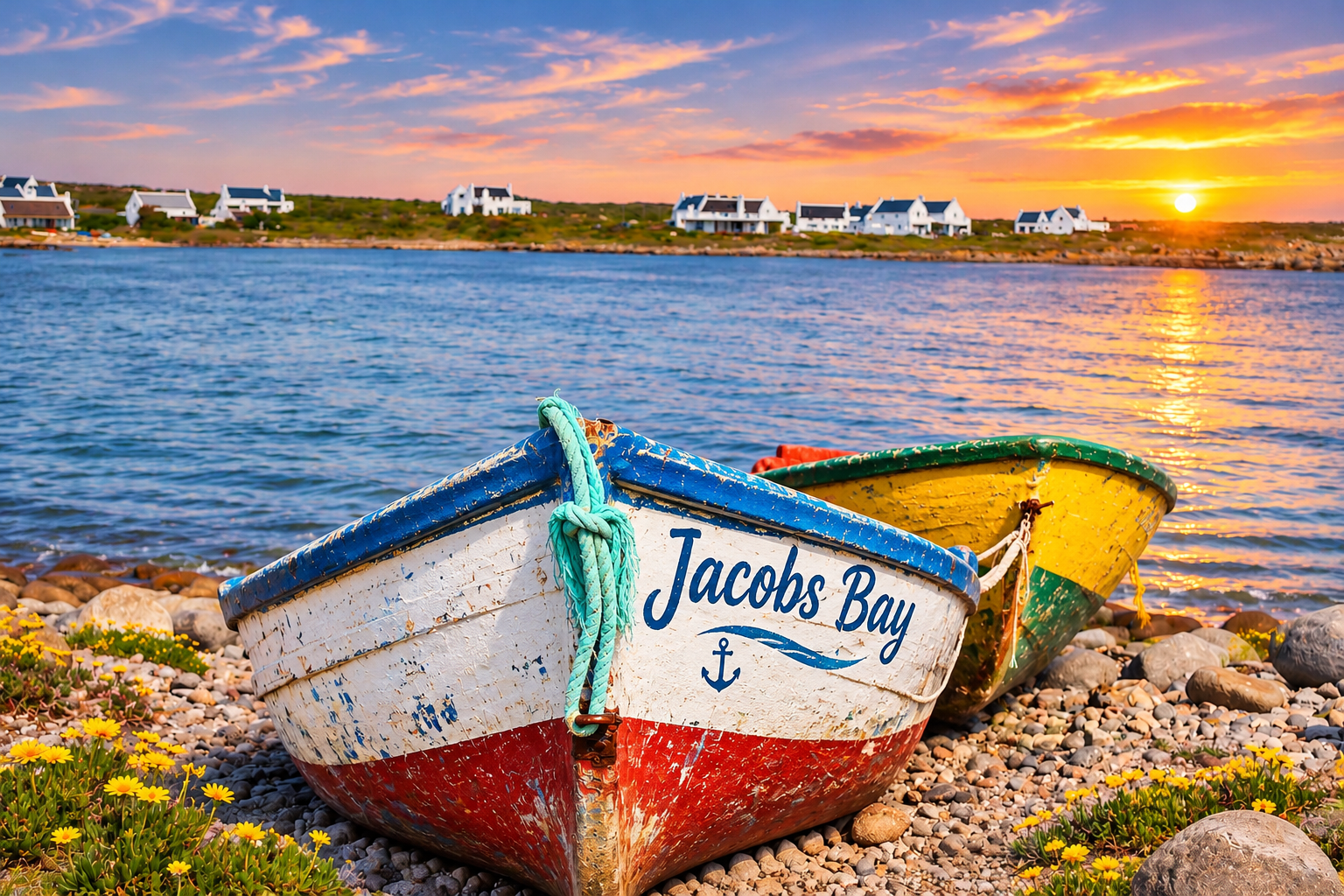
🌍 Town Spotlight: Jacobs Bay, Western Cape: Where Seven Bays Meet the Wild West Coast
Where seven bays, wild Atlantic waters and a village of timeless character come together.
There are places along the West Coast that feel as though they were designed for holidays, and then there are places that feel as though they were simply allowed to become beautiful.
Jacobs Bay belongs firmly in the second category.
Tucked between Saldanha and Paternoster, Jacobs Bay is one of those rare West Coast villages where the landscape, architecture and sea seem to belong to the same story. The coastline is rugged and rocky, the roads are largely gravel, the homes have a distinctive West Coast character, and the Atlantic is never far from view.
But perhaps the most remarkable thing about Jacobs Bay is that it isn't simply a coastal village facing one beach.
It stretches along a coastline of small bays — seven of them — each with its own character, history and relationship with the sea.
Hospital Bay, Jacobsbaai, Bamboesbaai, Smalbaai, Kwaaibaai, Mauritzbaai — locally known as Moerie-se-Baai — and Tooth Rock form a remarkable chain along this little-known section of the West Coast. The municipality describes Jacobsbaai as extending for approximately four kilometres along the coast, with these seven bays creating the distinctive shape and personality of the settlement.
Seven bays may sound like a small geographical detail.
In Jacobs Bay, they are part of the story.
A Village Shaped by the Sea
Long before Jacobs Bay became a place for weekend escapes, its coastline had a much more practical purpose.
The settlement's history stretches back to the early 1800s, when the area was connected to trading and fishing activity along the West Coast. Even the origins of the name Jacobsbaai remain uncertain, with historical explanations linking it either to Jacques Titius, a colonial trader, or to Jacob, a Gonneman Khoikhoi chief.
Then there is Hospital Bay.
Its name carries one of the most unusual pieces of Jacobs Bay's history.
During the 1800s, ships travelling towards Cape Town would leave sick sailors at the isolated bay to be quarantined before they continued their journey. What is today a peaceful coastal corner therefore once had a very different role in the lives of sailors travelling along the Cape coast.
The history has not completely disappeared either.
At low tide, the wreck of the Barge Margaret, which ran aground in 2009, can still be seen from Hospital Bay.
It is a fitting reminder that this coastline has always been about more than scenery.
The sea brought people here.
It provided food.
It created livelihoods.
It shaped the settlement.
And even today, it remains the defining presence of Jacobs Bay.
Seven Bays Along One Wild Coast
What makes Jacobs Bay particularly fascinating is the way the coastline keeps changing.
Instead of one long, sweeping beach, the village is tucked among rocky points, peninsulas and small sandy bays. Some are sheltered, some are more exposed, and each seems to reveal a slightly different version of the Atlantic.
There is something wonderfully old-fashioned about the names too.
Hospital Bay.
Jacobsbaai.
Bamboesbaai.
Smalbaai.
Kwaaibaai.
Mauritzbaai.
Tooth Rock.
They sound less like resort destinations and more like names that have been passed down through generations of people who knew the coastline intimately.
And perhaps that is exactly what makes them so evocative.
The bays are not simply places on a map. Together, they explain the shape of the village and the way people have lived beside this coast.
A West Coast Village With Rules About Beauty
Then there is another reason Jacobs Bay looks so different from many other coastal settlements.
Its architecture.
The municipality has specifically noted that residential development in Jacobsbaai takes place according to strict architectural guidelines, with the intention of creating and protecting a typical West Coast town character.
That principle can be seen in the village's visual language.
Whitewashed and lime-washed walls, stone, simple forms and traditional West Coast-inspired roofs sit naturally against the muted colours of the surrounding landscape.
The architecture does not attempt to compete with the ocean.
It seems almost deliberately designed to sit quietly beside it.
And that is an important distinction.
Jacobs Bay is not a village where every building is necessarily identical or where every property has exactly the same architectural treatment. Different areas and developments can have their own guidelines, and individual homes naturally vary.
But the broader idea is remarkably consistent: development should respect the character of Jacobs Bay rather than erase it.
It is a philosophy that has helped the village retain something increasingly rare along popular coastlines — a sense of place.
There are no traffic lights dominating the landscape. There is no major shopping centre or collection of chain stores defining the village. The roads remain largely gravel, and commercial activity is deliberately limited.
The municipality describes Jacobsbaai as a small, quiet hamlet with very limited commercial development — a place where the natural environment remains the dominant feature.
And perhaps that is precisely why the architecture works so well.
The houses do not need to be spectacular.
The setting already is.
Namaqualand by the Sea
There is another side to Jacobs Bay that appears only for part of the year.
Spring.
After the winter rains, the surrounding fynbos can transform dramatically. Flowers begin appearing between the rocks and across the coastal landscape, bringing colour to a place that can otherwise seem dominated by whites, greys, greens and deep Atlantic blues.
Locals have given Jacobs Bay a particularly beautiful description:
“Namaqualand by the sea.”
It is easy to understand why.
Instead of the flowers stretching across a dry inland landscape, here they meet the Atlantic.
Daisies and other wildflowers can weave through the fynbos while the ocean forms a brilliant blue backdrop. The result is one of those uniquely South African landscapes where the seasons completely change the personality of a place.
For a few months, the rugged coastline becomes a canvas of colour.
Then the flowers disappear again, leaving the rocks, sea and fynbos to reclaim the landscape.
A Place That Has Chosen to Stay Small
Perhaps the most interesting thing about Jacobs Bay is not any single attraction or landmark.
It is the decision — whether through planning, circumstance or simply the nature of the community — to remain small.
The village has developed without becoming a conventional coastal resort.
There are still gravel roads.
There are still quiet corners where the sound of the ocean is louder than traffic.
There is still a strong connection between the homes and the landscape.
And there is still a feeling that you have arrived somewhere rather than simply entered another suburb.
The natural environment remains central to life here.
The surrounding fynbos supports wildlife such as duiker, steenbok and tortoises, while the coastline attracts seabirds, dolphins and, at certain times of year, whales. Fishing remains part of the area's identity too, with Jacobs Bay historically known for its crayfish, fish, mussels and abalone.
The sea is therefore not merely something to look at from a holiday house.
It is part of the village's identity.
It is in the history.
It is in the food.
It is in the names of the bays.
It is in the wildlife.
It is in the weather.
And it is in the feeling that settles over Jacobs Bay when the afternoon wind drops and the sun begins to fall towards the horizon.
The Beauty of a Place That Has Not Tried Too Hard
There is a temptation, when writing about a beautiful destination, to list everything that makes it worth visiting.
Jacobs Bay doesn't really need that.
Its appeal is found in the combination.
The seven bays.
The rocky Atlantic coastline.
The whitewashed homes.
The gravel roads.
The wildflowers in spring.
The fishing history.
The quiet.
The fynbos.
The enormous sky.
The absence of the things that usually tell us we are in a modern holiday destination.
Jacobs Bay has not tried to become something bigger than itself.
And perhaps that is why it has become something memorable.
It is a place where the landscape still feels stronger than the development around it. Where the architecture has been encouraged to respect the setting. Where history survives in the names of bays and old stories. And where a coastline of small, individual coves has created a village with a character entirely its own.
Seven bays.
One rugged stretch of West Coast.
A village shaped by the sea.
And a little corner of the Western Cape that has quietly managed to remain unmistakably Jacobs Bay.