
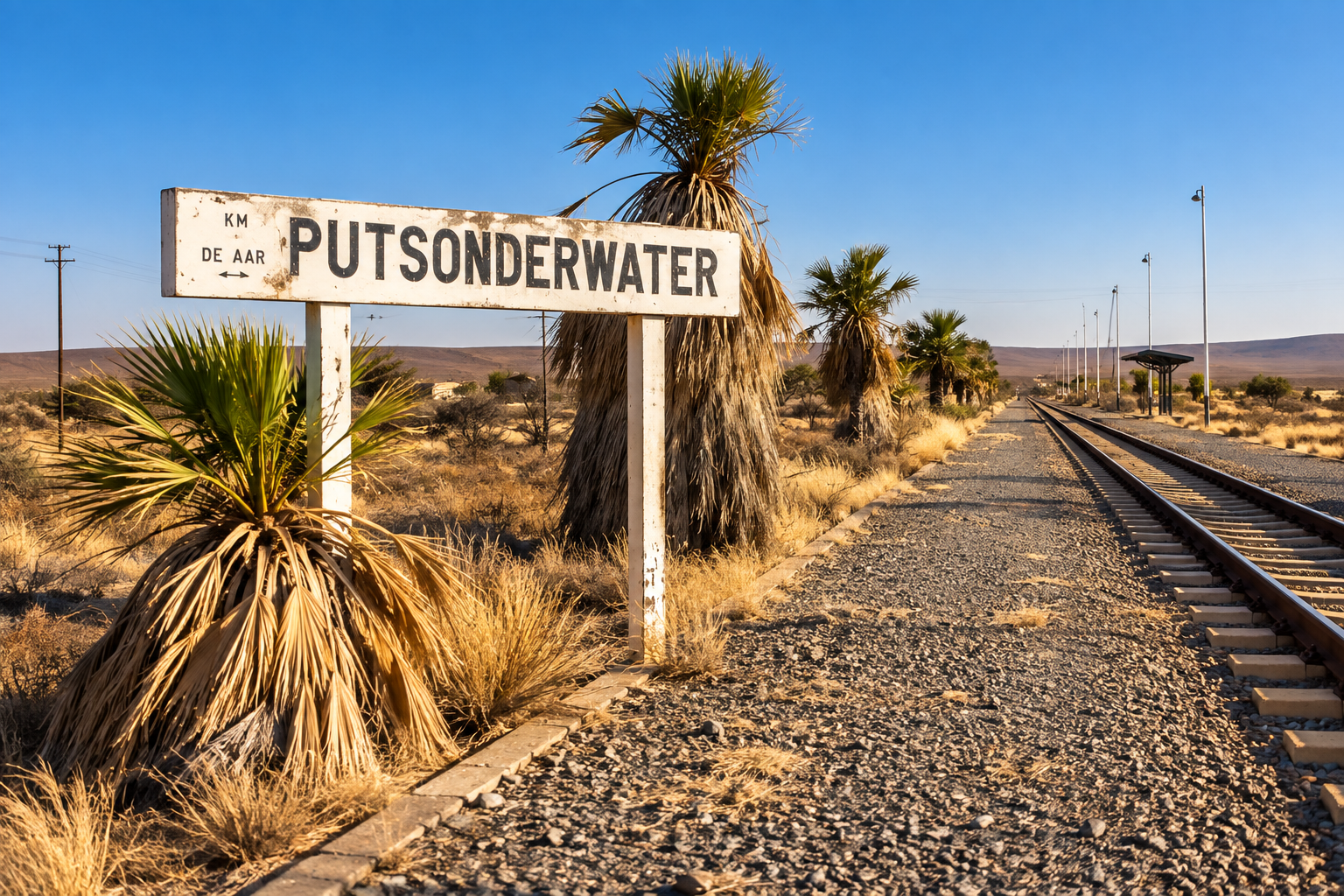
🌍 Town Spotlight of the Week: Putsonderwater: The Railway Town That Time Forgot
From an award-winning railway station garden to a forgotten ghost town — the remarkable story of Putsonderwater.
There are few South African place names quite as evocative as Putsonderwater. The name itself sounds almost mythical, conjuring up images of a distant place at the edge of the country. Yet Putsonderwater was once a real and active railway settlement, with families, businesses, a school, a church and a railway station at the centre of community life.
Today, it is regarded as one of the Northern Cape's ghost towns.
Scattered buildings, abandoned homes, the remains of the old railway settlement and the railway line itself remain beneath the enormous Karoo sky. It is difficult to imagine that this quiet and isolated place was once an important stop along the railway route between Cape Town and Windhoek.
When the Railway Brought Putsonderwater to Life
Putsonderwater's history is closely connected to the railway.
For many years, the railway was the lifeline of the settlement. It brought people, supplies and employment to this remote part of the Northern Cape and provided an important link between isolated farming communities and larger towns.
Putsonderwater developed into a small but functioning community. At its height, the settlement had a hotel, general dealer, police station, post office, school and inter-denominational church.
Railway employees and their families lived in the settlement, while surrounding farmers relied on the railway to transport livestock, agricultural products and other goods.
The railway station was the heart of Putsonderwater.
And remarkably, this little station became nationally recognised for something quite unexpected.
An Award-Winning Railway Station 🌹
In 1989, Putsonderwater railway station won the prestigious Lady Duncan Trophy for South Africa's best-kept country railway station.
It is an extraordinary detail in the history of a place that is now largely abandoned.
The station was once beautifully maintained, with gardens, roses, pathways and a wishing well. In the middle of the dry Northern Cape landscape, the carefully tended gardens must have created a striking contrast.
The station was not simply a place where trains stopped. It was an important part of everyday life.
Railway employees maintained the station, water supply and other facilities, while goods and passengers moved through the settlement. The arrival of a train connected Putsonderwater with the much larger world beyond the surrounding plains.
For a remote settlement, the railway provided a sense of purpose and connection.
The Beginning of the Decline
Putsonderwater's decline was gradual rather than sudden.
The settlement depended heavily on the railway and the agricultural economy of the surrounding region. When that economy began to weaken, the effects were eventually felt throughout the community.
A succession of droughts placed enormous pressure on farming in the region. Cattle numbers and trading activity declined, reducing some of the economic activity that had supported the railway.
At the same time, changes to railway services began to isolate Putsonderwater further.
Passenger trains that had once stopped at the settlement became less frequent and eventually stopped altogether.
Without the regular movement of people and goods, the railway could no longer provide the same economic foundation it once had.
And slowly, Putsonderwater began to empty.
One Service After Another Disappeared
The decline followed a pattern that has affected many isolated rural communities.
As economic activity decreased, businesses and public services became increasingly difficult to sustain.
The police station closed.
The post office closed.
The hotel closed.
The general dealer closed.
The railway became less important.
As these services disappeared, there were fewer reasons for families to remain in Putsonderwater.
People began moving to other communities where they could find employment, schools, shops and essential services.
The railway settlement that had once depended on the arrival of trains was gradually losing the very activity that had created it.
The School Held On
One of the most remarkable parts of Putsonderwater's story is that the local school continued operating long after many other services had disappeared.
The school remained an important part of the remaining community until 2004.
But by then, there were simply too few people left to sustain the settlement.
With declining population, limited services and difficult living conditions, the school eventually closed.
The closure marked another significant chapter in the disappearance of Putsonderwater as a functioning community.
Many former residents eventually moved elsewhere, including to nearby Marydale.
From Railway Settlement to Ghost Town
Today, the difference between the Putsonderwater of the past and the Putsonderwater travellers encounter is remarkable.
Buildings that were once occupied are now weathered and abandoned.
The businesses that once served the community are gone.
The school has closed.
The station gardens that once helped Putsonderwater win recognition as one of South Africa's best-kept country railway stations are long gone.
Yet the railway itself remains an unmistakable reminder of the settlement's past.
The tracks stretch across the vast Northern Cape landscape, following the same route that once brought passengers, railway workers and goods into this isolated community.
Old buildings remain scattered around the railway line, offering glimpses of what life must once have been like.
And the enormous sociable weaver nests found throughout this part of the Northern Cape add another fascinating feature to the landscape.
A Place Frozen in Time
Perhaps the most fascinating thing about Putsonderwater is that its story is not ancient.
This was not a settlement that disappeared centuries ago.
People living today can remember when Putsonderwater was a functioning community.
Children went to school.
Families lived in railway houses.
The hotel served travellers.
The general dealer supplied local residents.
The post office connected people with the outside world.
The church brought the community together.
And trains arrived at the station.
Then the economic foundations began to disappear.
Drought affected agriculture.
The cattle trade declined.
Railway services changed.
Businesses closed.
People moved away.
The school eventually closed.
And Putsonderwater slowly fell silent.
Why Putsonderwater Still Matters
Putsonderwater is more than simply an unusual name on a map.
It represents an important part of South Africa's railway history and tells the story of how railways once created communities in some of the country's most remote landscapes.
It is also a reminder of how closely many small settlements were tied to the industries and transport networks around them.
When those economic foundations disappeared, the communities often disappeared with them.
Today, Putsonderwater offers travellers a chance to experience something very different from a conventional tourist destination.
There are no bustling streets, busy restaurants or rows of shops.
Instead, there is an enormous Northern Cape landscape, an old railway line, weathered buildings and the remains of a community that once had a life of its own.
For those fascinated by history, railway heritage, abandoned places, photography and unusual South African destinations, Putsonderwater is a remarkable place to discover.
The rails remain.
The landscape remains.
The old buildings remain.
But the community that once depended on the railway has largely disappeared.
Putsonderwater is the story of a town that was built by the railway, sustained by the railway — and ultimately faded when the economic world around that railway changed.
A forgotten railway town beneath the vast Northern Cape sky. 🇿🇦